

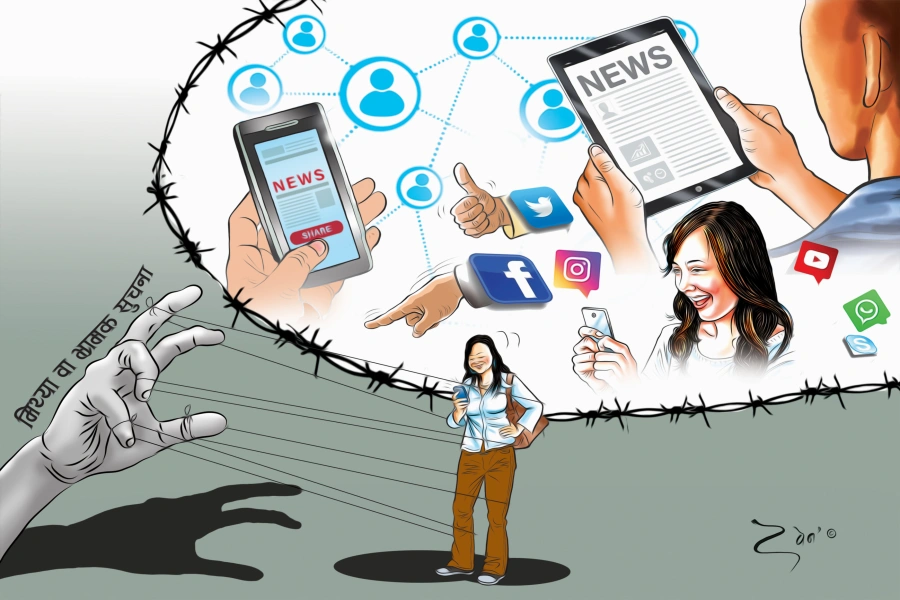
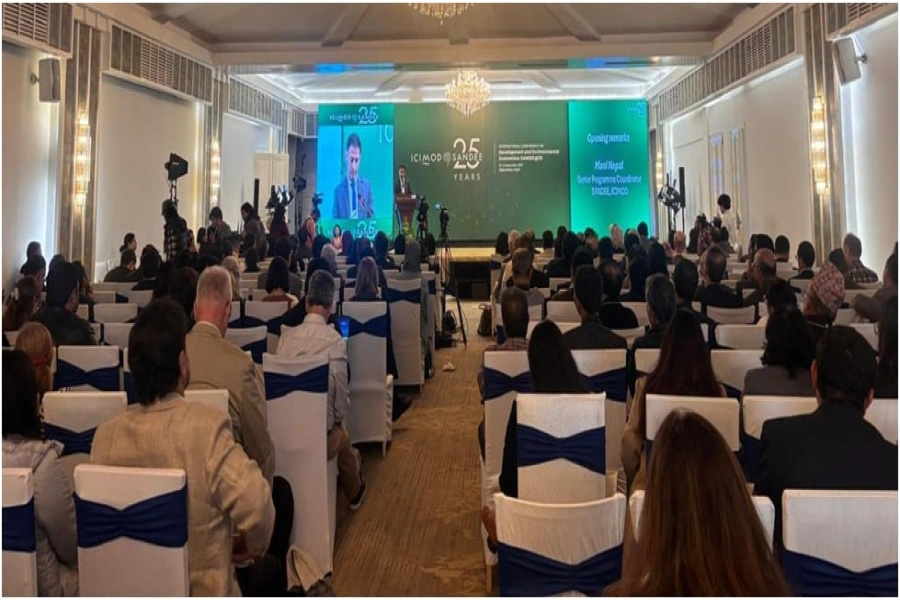
Recently I attended a regional event in Delhi on “South Asia Media viability” organized in partnership with UNESCO IPDC. A significant portion of our discussion involved large social media platforms and its impact on newsroom and media content. For Nepal, however, the pertinent question today is not just about newsrooms but the health of our democracy itself.
Nepal is a young democracy, with nearly 46% people under the age of 24 as per the latest national consensus. Meta has 14 million registered users from Nepal on Facebook-- almost half of our population residing in Nepal. Meta also claims to have the highest market share of approximately 83% of the total population using social media. This market dominance is understandable. Small business owners find marketplace access, brand visibility and easy outreach to customers. Regular users also find it convenient to communicate and stay in touch with family and friends. The list of benefits is endless but they all come at a cost.
One of the costs we as a society are bearing is the cost of disinformation and misinformation under the guise of freedom of expression. Unregulated platforms with low to no consequences result in a society that is able to freely express themselves in any form, in any subject and form, without any repercussions. This poses a higher risk when such platforms are systematically used to circulate wrong narratives and spread disinformation.
From Brexit to Kathmandu: How Disinformation Travels
It is useful to look beyond Nepal to understand the scale of this problem. In 2016, the UK voted to leave the European Union. During the Brexit campaign, Facebook had been under major scrutiny for allowing political campaigns led by pro-Brexit to run on their platforms using their targeted advertising tool to influence voter behavior. Campaigns were found to have run against UK electoral law. What appears in one's feed is highly personalized and private. This makes it almost impossible to track or verify any of these targeted campaigns that are used to impact people's decisions.
There are multiple issues with such political campaigns. The source of income used to plant these political campaigns are not verifiable and easily available. Whether these campaigns were spreading factual information or pushing misinformation is another difficult task to gauge. Journalist Carole Cadwalder conducted extensive investigation on this issue, producing multiple investigative pieces. A native of South Wales, she went back to her hometown on the day of the Brexit vote. The region had benefitted significantly from European Union (EU) funding, including a 33-million-pound college of further education, sports centre in the middle of a 350 million regeneration project. Despite this, there was a lot of dissatisfaction amongst the people in that region that purely stemmed from what they saw on social media. They complained about immigrants taking over jobs when this particular place had the lowest immigrant population in the UK. Cadwalder found all this misinformation was deliberately planted and targeted to individuals through newsfeeds. Whether Brexit was good or bad for the UK is not for me to judge. But this episode resulted in an Online Safety Act 2023. This Act empowers regulators like Ofcom to fine 10% of global revenue if these platforms violate the Act. In extreme cases, it can even block their services.
Nepal ranked 33rd most fragile state in the world

Now, fast forward nine years, the rise of AI has made it much easier to amplify misinformation and create narratives that are completely misleading. Individuals or entities living in a foreign country can run multiple campaigns on social media platforms targeting Nepalis and influencing them to believe in their agenda. While some users may try to verify these feeds, most others will not. Using large platforms as a vehicle to influence and manipulate people's minds with zero transparency is extremely dangerous. It risks eroding the institutions we have worked so hard to build.
On September 8, 2025, Gen Z protestors took to the streets in Kathmandu against poor governance and rampant corruption. While young kids came out to protest purportedly against rampant corruption and poor governance, the protest was triggered by the ban on social media. In the months that followed, I have seen all issues raised, issues as extreme as a directly elected head of the government has surfaced. Yet one critical issue of our time has remained consciously absent: Why did the then government felt it necessary to consider such a ban? What is wrong in bringing large platforms under Nepal's legal jurisdiction if they want to do business in Nepal.
Monetisation a bait?
Most large platforms have not registered in Nepal. As someone who worked in the media I can honestly say media houses have institutionally benefitted from social media a lot more than individual users. Our digital traffic is driven largely through these social media platforms. Our content is monetised and we livestream video using Youtube or Facebook without paying a cent on server infrastructure while generating revenue per view. The local economy doesn't actually impact how we generate money through social media. Social media have emerged as promising sources of revenue for the media industry in trying times. But the larger question remains: at what cost?
A few years ago, Meta had an instant article feature that helped news publishers in Nepal to grow their audiences and earn a modest monthly revenue. But this feature was abruptly shut down and Meta stopped paying Nepali users for the content they pushed on social media. This was a harsh reminder that when you depend too much on these large platforms they will only fail you and leave you with a business model that is extremely fragile. While the Government of Nepal asked large platforms to register in Nepal in mid-July almost a month before the Gen Z protest, our Facebook pages automatically started monetizing. This, I hope, was a coincidence. Today I hear this feature spans across every user and in our newsroom I hear giggles and laughter as a lot of our journalists’ page is now eligible to monetise on its own. Everyone is trying to make a few bucks on the side.
This has left me to reflect again: what are we willing to lose for a few extra bucks? The problem is not so much about professionals creating content to influence their community but about creating content outside their professional expertise in order to gain eyeballs and attraction. This experimentation by large platforms to get people hooked into using their platform consistently feels like a slow poison, eroding our society and the values it holds. While these platforms are using our people rampantly to benefit from multiple things they are not under any Nepali regulation or law. In essence, they exist above the law and we have quietly accepted it.
Too Small to Regulate, Too Vulnerable to Ignore
A study conducted by Cyabra, a cyber intelligence company, states that 34% of content on social media during the Gen Z revolution was fake or AI generated. While the authenticity of the figure is subject to further verification, the broader trend this shows is undeniable. Almost all countries are facing this type of ‘disinformation crisis’ that is shaking their long built institutions and democratic values. Nepal is no exception to this. AI-generated content, amplified by targeted political narratives, has the potential to pose a serious challenge to our already fragile democratic system.
The World Economic Forum has listed “Disinformation” as the biggest global risk facing humanity. This research comes at a time where more than half the world population will vote between 2024 and 2026, Nepal’s upcoming election falls squarely within this period. There are virtually no mechanisms in place in Nepal to shield itself from the catastrophe of AI generated content amplified by social media platforms through their target marketing tools to create false and misleading narratives.
This brings me to the point of discussion I had with my fellow panellist at the conclave. While he represented the new age digital aided news media, I represented what we jokingly called “the legacy media”. He was very optimistic that social media, with the use of AI, will further strengthen our democratic norms. But I was deeply worried. His argument stemmed from the fact that previously there were a handful of people who “controlled” information, whereas today it's someone else i.e. the large platforms and their algorithms, something similar on a different scale. My apparent argument was simple: those who worked as gatekeepers earlier were accountable to the law and faced reputational damage and financial consequences. Today, there are none.
Sovereignty in the Age of Scale
Our debate ultimately revealed a deeper truth: our national context matters. In India, all the top MNC and large platforms have their offices set up —something they do not have in Nepal. Small countries like Nepal are far more vulnerable to disinformation, fake news and misleading campaigns. Our democratic systems are fragile, our institutions are weak and social media aided with AI generated content at industrial scale with very little to no way of differentiating authentic and non-authentic swarm our social media newsfeeds. They can easily influence public judgement.
Large platforms refuse to register in Nepal. Meta does not provide publisher services here. Australia’s News Media Bargaining Code (NMBC 2021) forced Google and Meta to negotiate with publishers. The EU's Digital Service Act demands large platforms to provide more transparency and immediately remove fake and harmful content. Canada’s Online News Act (Bill C-18) has mandated a certain framework for these large platforms. In India, the debate revolves around how benefits are shared among large newsrooms. But in Nepal, the issues are different. We are not even recognised as a country. Our sovereignty doesn’t matter to these big tech companies because we are “small" and we do not give them ‘scale’.
A lot of Nepali businesses spend money on google advertising. Yet google advertisement does not recognise Nepali language on Google Ads. All the advertisements that Nepali people spend on google are not coming back to Nepal in any form. It is not unjustifiable to demand Google as a service provider to at least give their paying customers that space in platforms where Nepalese spend significant time to post social media. Google already recognises 10 languages including Hindi, Urdu, Malayalam and Kannada spoken in India. Recognising Nepali as a language by Google advertisement wouldn’t come at any cost. Instead such a move would make an entire country feel seen. Nepali is Nepal’s official language.
Path Ahead
While I write how democracy like ours is at the highest risk from social media platforms, there are compelling arguments on how social media platforms have empowered diverse voices. They have given the much-desired tool to new political candidates to launch campaigns and win electoral votes. Digital movements have made the government more accountable. They have also resulted in the decline of the “controlled media ecosystem”. While I subscribe to all these arguments, my deepest concern remains unchanged. My worries come from the fact that these large platforms do not abide by the laws of the land and increasingly their attitude to abide by them comes unfairly at the cost of scale and power. As politicians have lately started exploiting this weakness to their advantage by discrediting even genuine information simply calling them ‘AI-generated’, the challenge for our democracy is only growing. Hence when Google or Meta talk about democracy and freedom of expression, I remain sceptical. As the saying goes, you are as good as your weakest link. Any attempt to ignore young democracies in the pretext of geographic size and demographic scale is neither transparent nor fair—and certainly not democratic. The onus therefore lies on us. We must acknowledge the fact that any legislation including the Electronic Transaction Act 2008 that fails to bring these big tech companies under Nepal’s legal jurisdiction will be neither effective nor meaningful in combating disinformation.
(The author is the Managing Director of Nepal Republic Media Limited.)
















-1765616104.webp)