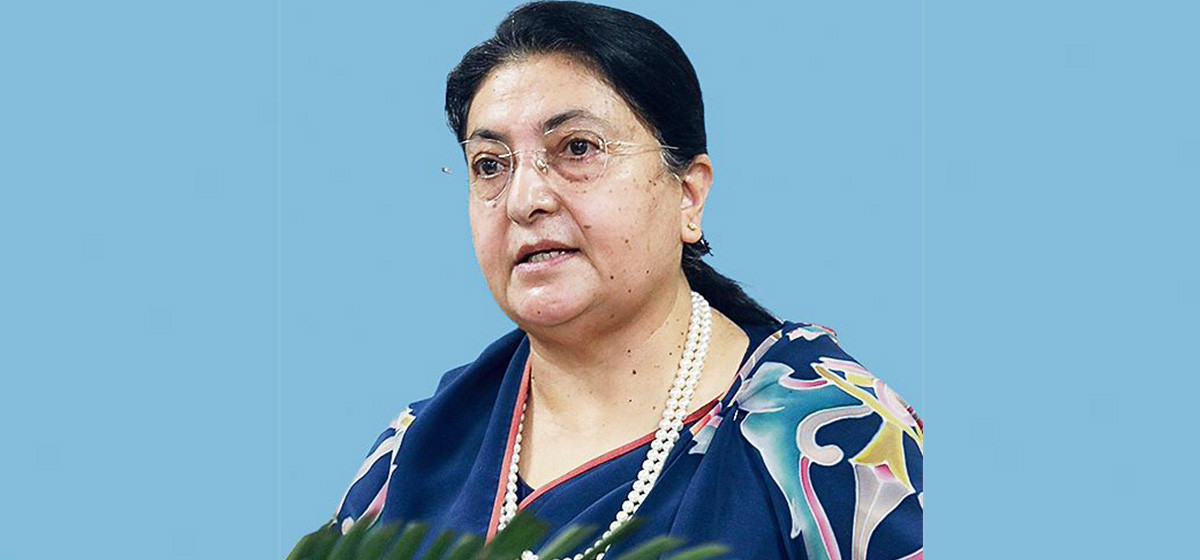
KATHMANDU, July 20--The CPN-UML politburo meeting saw intense discussions on whether former President Bidya Devi Bhandari should be restricted from active party politics. During the two-day meeting held Saturday and Sunday, leaders revisited previous issues raised by party chair KP Sharma Oli—notably the two-term leadership policy, the 70-year age limit, and internal party democratization.
Most leaders emphasized that practices related to democratization within the party had originally been initiated by Oli himself, and that current developments—particularly Bhandari's political initiative—do not exceed those boundaries. Referring to practices from 2010 to 2014, they argued that Bhandari’s actions are in line with what Oli had once championed.
Quoting Oli’s 2010 paper presented at a national orientation program organized by the Madan Bhandari Foundation, they said:
“Democratization is a method of revitalizing the party. Once in leadership, prioritizing factional interests, sidelining thoughtful and creative comrades over minor disagreements, and fostering a culture of praise while resisting criticism—such narrow attitudes weaken party life. We must remove these tendencies and adopt democratic norms.”
No one should dream of going against democracy: PM Deuba

On this basis, leaders argued that Bhandari's political engagement should not be blocked.
The age limit became a key topic of debate, as Oli himself has now turned 73. According to the UML statute, leaders above 70 are not eligible for leadership roles—a rule that has only been temporarily suspended, not revoked. While it was claimed the rule was lifted to accommodate returnee Mukunda Neupane from the Socialist Party, many now believe it was primarily done to pave the way for Oli’s third term as chair.
Senior Vice Chair Ishwar Pokharel vocally defended the age limit. He and his faction oppose allowing Oli a third term, and are pushing for a statute amendment to bar any official from holding a third term in leadership. This proposal was prominently raised in the politburo meeting.
Interestingly, Bhandari herself is seen as involved in these efforts to counter Oli’s continuation. Meanwhile, a new generation of leaders opposed to her political comeback also became active, creating a visible rift within the meeting.
Leaders like Karna Thapa vocally endorsed the slogan “Madan’s Ideology: Bidya’s Leadership,” confirming Bhandari’s ambition for central leadership. On July 28, during Madan Bhandari’s 74th birth anniversary program organized by his foundation, Bhandari formally announced her return to active politics after stepping down from the presidency.
“I have renewed my party membership,” she said. “I have rejoined UML as a regular member.”
However, both Oli and General Secretary Shankar Pokharel gave ambiguous responses about her membership renewal, fueling tensions in the politburo.
“The assumption that KP and Bidya wouldn’t compete, given their long political partnership and personal rapport, has been disproven in this meeting,” noted one politburo member.
Rajendra Gautam, head of the party’s publicity department, confirmed that the meeting saw extensive discussion on issues like the 70-year age limit, the two-term rule, and Bhandari’s return to politics.
“These issues—including her membership—were raised by many,” he said.
Politburo members Gokul Baskota, Anand Pokharel, and Suman Pyakurel called for the resolution of disputes between Oli and Bhandari. Baskota, taking a centrist line, suggested that no one should be barred from participating in politics and called for dialogue.
He advised both Oli and Bhandari to work things out through internal discussion. “Everyone knows about the close working relationship and mutual trust between the two. Settle this issue politically, not technically,” he urged.
He also called upon the younger generation in the party to show their leadership by helping resolve the conflict.
Anand Pokharel strongly argued against sidelining Bhandari and others wishing to work through proper procedures. “I urge Chair Oli and the entire leadership: Let’s welcome back former President Bhandari and others who want to work within the system, not reject them,” he said.
On the other hand, Mahesh Basnet opposed Bhandari’s return to active politics, saying, “Comrade Bidya has held the dignified post of President. Returning to active party politics undermines that stature. It’s both an ethical and procedural mistake. This contradicts democratic norms and inner-party democracy.”
He also defended the 70-year age limit, stating, “We created that standard ourselves. We lifted it temporarily when needed. But now, it seems unjustified. Retirement shouldn’t be automatic—it should be based on capacity and choice. However, let’s not create double standards: we can’t say age limits don’t apply to leaders like Mukunda Neupane, but then ignore them for others.”
He concluded, “The two-term limit was lifted by the general convention. Let’s not label leaders or the party as conspiratorial for trying to enforce the rules. Let’s build a culture of leadership based on merit and capacity. The proposal to lift the age cap is already at the secretariat. Let’s pass it.”

-1765616104-1765618344.webp)
















-1765616104.webp)